Friday, 9 July 2021

My Reader Response of Analysis Snow White

 When examining “Snow White” from a reader response perspective, it becomes clear that Snow White serves as a warning to children (specifically girls) about the dangers of vanity. Although Snow White's goodness is tied to her beauty, her desire for beautiful things nearly kills her.

"Snow White - Disney Princess" by timz2011 is licensed under CC BY-NC-SA 2.0


I read many fairy tales as a little girl, and the one message that I received over and over was that good people are beautiful and bad people are ugly, so when I read “Snow White,” even as an adult, I expect that in fairy tales, the beautiful people are good and the ugly people are bad. However, in this story, the queen is both evil and beautiful, but her vanity and desire to be “fairest of all” turns her into a hateful would-be murderer and cannibal, as is evident when she thinks she is eating Snow White's heart and lungs.

Snow White herself is depicted as a good girl because she is willing to be a good housekeeper for the dwarves. I tend to balk at this estimation of goodness because as a modern woman, I don't like the idea that women are only valued for their domestic skills, and think the dwarves should be willing to protect her even if she is not a good housekeeper. However, although she is “good” she is also vain. When the wicked queen tries to trick her, she doesn't tempt her with goods that will make her housekeeping job easier; she tempts her with trinkets: pretty silk bodice laces, a comb, and a “beautiful apple.” In spite of the dwarfs’ warnings, she falls for the queen's tricks and “dies” from eating the poisoned apple. It appears to me that she is being punished for her vanity and desire for things that are not “domestic.”

After the prince rescues Snow White, they punish her evil step mother by forcing her to dance to death in hot iron shoes. I am of course horrified by how gruesome this punishment is. I realize that children in the time of the Brothers Grimm would be more accustomed to death, pain, and the general brutality of life, but I still find the punishment shocking given the fact that I was raised to believe that children should be sheltered from violence. This suggests to me that the evil queen's punishment is not just a horrifying lesson for children about the dangers of vanity, but a warning for Snow White as well.


A Reader Response of Snow White

When examining “Snow White” from a reader response perspective, it becomes clear that Snow White serves as a warning to children (specifically girls) about the dangers of vanity. Although Snow White's goodness is tied to her beauty, her desire for beautiful things nearly kills her. 

I read many fairy tales as a little girl, and the one message that I received over and over was that good people are beautiful and bad people are ugly, so when I read “Snow White,” even as an adult, I expect that in fairy tales, the beautiful people are good and the ugly people are bad. However, in this story, the queen is both evil and beautiful, but her vanity and desire to be “fairest of all” turns her into a hateful would-be murderer and cannibal, as is evident when she thinks she is eating Snow White's heart and lungs.

"Freezing at St. Michael's" by Trey Ratcliff is licensed under CC BY-NC-SA 2.0


Snow White herself is depicted as a good girl because she is willing to be a good housekeeper for the dwarves. I tend to balk at this estimation of goodness because as a modern woman, I don't like the idea that women are only valued for their domestic skills, and think the dwarves should be willing to protect her even if she is not a good housekeeper. However, although she is “good” she is also vain. When the wicked queen tries to trick her, she doesn't tempt her with goods that will make her housekeeping job easier; she tempts her with trinkets: pretty silk bodice laces, a comb, and a “beautiful apple.” (Grimm, 34)  In spite of the dwarfs’ warnings, she falls for the queen's tricks and “dies” from eating the poisoned apple. It appears to me that she is being punished for her vanity and desire for things that are not “domestic.”

    After the prince rescues Snow White, they punish her evil step mother by forcing her to dance to death in hot iron shoes. I am of course horrified by how gruesome this punishment is. I realize that children in the time of the Brothers Grimm would be more accustomed to death, pain, and the general brutality of life, but I still find the punishment shocking given the fact that I was raised to believe that children should be sheltered from violence. This suggests to me that the evil queen's punishment is not just a horrifying lesson for children about the dangers of vanity, but a warning for Snow White as well.


Work Cited

Grimm, Johaness. "Snow White". Penguin Publishers, June 13, 1887. Print 


Thursday, 6 May 2021

MARXIST THEORY ON LSHOFBKSNFKN


Nam liber tempor cum soluta nobis eleifend option congue nihil imperdiet doming id quod mazim placerat facer possim assum. Typi non habent claritatem insitam; est usus legentis in iis qui facit eorum claritatem. Investigationes demonstraverunt lectores legere me lius quod ii legunt saepius. Duis autem vel eum iriure dolor in hendrerit in vulputate velit esse molestie consequat, vel illum dolore eu feugiat nulla facilisis at vero eros et accumsan.
Subsection heading. Lorem ipsum dolor sit amet, consectetuer adipiscing elit, sed diam nonummy nibh euismod tincidunt ut laoreet dolore magna aliquam erat volutpat. Duis autem vel eum iriure dolor in hendrerit in vulputate velit esse molestie consequat, vel illum dolore eu feugiat nulla facilisis at vero eros et accumsan.


dljbdgbfkjgbkdfbgkjbdfkgbdfkjbgkdfkjgbdfkjbgkbgkbdfgbdfkbgkjdfb dklsfghdfkhgfdhgkjdbgjkbfdkgbkf fkgbdfkbgkbgkbdfkg ksdbkgv
"Improv circles pillow" by stitchindye is licensed under CC BY-NC-SA 2.0

,xvbjkdsbgfdjkbskjgdbskjgbkjgbkjfbkgbdkfbg


Monday, 9 April 2018

Blog Post #4: Feminism in The Bluest Eye

Taken from "Feminism is an Un-African Concept "by Sukoluhle Hadebe

            Wow. It's been quite the journey with this novel, The Bluest Eye by Toni Morrison. It has been an emotional experience reading this book, especially for the purpose of analysis, but I must contend that it was the feminist theory that gave me the most insight. 

            The most obvious reason for this is the book was written by a woman and about women. This led me to believe that it was also written for women.  As I read, as a young Black woman myself,  I could identify with the feelings of inferiority when compared to my "white" counterparts. It also caused me to respond emotionally because the entire book was essentially about how women need to empower themselves so they can empower each other. Feminism is about women being seen as equal with men, but it's also about women having leadership roles and breaking free from submissive stereotypes. In the text, Morrison explores this in the juxtaposition of Pauline: the perfect servant (more on that here) and the three prostitutes Miss Marie, Miss China and Miss Poland: the women who make their own rules and make the men in their lives serve them

          Along with this juxtaposition, Morrison's conclusion of the novel brings this entire idea home, i.e., the idea of women uplifting themselves and subsequently uplifting each other. After Pecola was raped by her father, impregnated and suffered a miscarriage, she had a psychotic breakdown. Claudia comments on how, after that, the community was ashamed of what they had allowed to happen. 

"We tried to see her without looking at her...because we had failed her." (Morrison 204-205)

Morrison then goes back to how the novel began, Freida and Claudia planting flowers for Pecola's baby that refused to grow. In the beginning, they blamed themselves for planting the seeds too deeply, but at the end of the novel, that idea changes to not blaming themselves, but blaming the soil. To me, this represents the fact that because they were already broken, sad, and did not love themselves, they didn't know how to love and uplift Pecola. 

"This soil is bad for certain kinds of flowers," Claudia says. "Certain seeds it will not nurture, certain fruit it will not bear..." (Morrison, 206) 

        Through the feminist theory, I saw the importance of this novel for today's Black woman. Even though society has made many strides in combatting the idea of racism and stereotypical gender roles, there are still so many women, TOO many women, who feel like they are less than others, who hate themselves and hurt themselves because they think they deserve it. By craving that "bluest eye" like Pecola, by wanting to change themselves into what society wants, they end up hurting themselves. Feminist theory denounces this idea and challenges this narrative. It highlights the dangers of following this narrative (Pauline's family got destroyed because she was too focused on serving others and not uplifting herself); Claudia was too sickened by self-hate to help her friend. 

Overall, I enjoyed this perspective for what it forced me to see about myself and our society and reading this book has definitely changed my life. 


Friday, 6 April 2018

Blog Post 3: Women in the Spring time


         The Bluest Eye by Toni Morrison has so far been quite an emotional journey. It started out with the first-person narration of Claudia, but it morphed into shorter multiple-narrated vignettes of the other characters that Claudia has encountered in the book. In this third chunk entitled "Spring", I had hoped for a more positive outlook on the characters' lives since enduring the tragedy of the previous section, "Winter". However, this section seems to highlight how the Black women of America's 1940s were treated and how it led to a lot of the tragedy that took place in the earlier parts of the book.
   
            One of the things that struck me when analyzing this from a feminist perspective, is that all the Black women in the book seem broken; even the little girls, in a way that seems irreparable. Broken because they are black and therefore unlovable, unlike their white counterparts.

Image result for racism in america 1940s
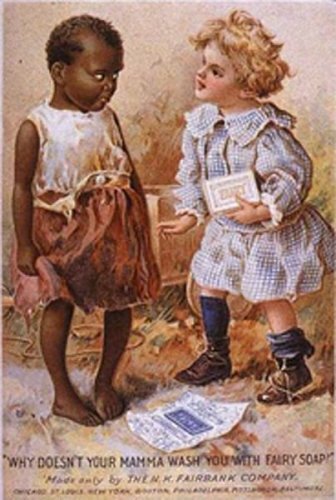
Circa 1875, Fairy Soap
         This section focused on Pecola's mother, Pauline. She grew up handicapped because of an injury to one of her legs and spent her childhood virtually ignored, even more ignored than the black children at that time usually were, because their parents were also broken and too busy and ill-equipped to love them as they needed. She never felt loved or cared for, which echoes the Freida and Claudine, and said she basically only found happiness in taking care of the house.
     
         It would make sense for her to feel like this, as in those days the pre-conceived gender notions that we have started to let go of still existed: a woman's place was in the home. Add being Black to the mix in a post-slavery pre civil rights era and a BLACK WOMAN is definitely expected to always be a servant. That was Pauline. "She was not only good at housework, she enjoyed it." (Morrison, 112) To me, it's perfectly fine for a woman to enjoy housework. It's not okay for it to be seen as her duty and her only purpose in life, however.
     
Unidentified maid feeding a child


     When Pauline grew up, after getting married and having her children quite young (still a teenager), she became a housemaid for a white family, the Fishers. It was the only place, ironically, that she felt like she had any power and respect. It's such a beautiful ironic poetry moment that Toni Morrison has created here because, even though Pauline is considered a servant and beneath these white people with whom she works, by being associated with them, the people in the town treated her with more respect than anyone else ever had of her own race and even her own family.


        As a woman, she owns this false sense of power but her punishment was the demise of her own home. Her house fell to ruins because, of course, she was the one expected to do all the work, but she didn't. She focused her energy on the Fishers. She raised their daughter, she cleaned their house and did their laundry. She devoted her power to the wrong place and as a result, her own family fell apart.
 
          Her husband, Cholly, also suffered from lack of maternal love and transferred this loss into hatred for women. He used them as he saw fit and when he grew tired of them, he hurt them. Pauline became the only woman who could handle him, but unfortunately, because she had neglected her motherly duties, she was unable to protect Pecola, her only daughter, from Cholly. He raped her and caused her to become pregnant and led to her ruin as well. The brokenness of women as a result of broken men who were ALSO broken by broken women is the cyclical nature of poverty, racism and loss.

Not all women are maternal, but all mothers must be if they choose the path of motherhood, because if they aren't, this leads to devastating results.


Thursday, 5 April 2018

Blog post 2: Seasons in The Bluest Eye

‘The Masque of the Four Seasons’, Walter Crane

                 In this post, I'll talk about the novel The Bluest Eye from an archetypal perspective. By definition, an archetype is "an original pattern or model" (Guerin et al) and in literary analysis, an archetypal approach looks for patterns in a text that are similar in many other texts. In the novel, a very prominent archetype is that of the four seasons.
           
            First of all, the book is divided into four parts and each part is named after each season, starting from autumn and ending with summer. The archetype of autumn has a symbolism of tragedy and the first section of the book is definitely tragic. Morrison highlights the development of self-hatred in the young  Black girls in the book, Freida (10 years old), Claudia (her sister and main character, 9 years old) and Pecola, a 12-year-old girl who was even poorer than Freida and Claudia and came to live with them after losing her family home. 

             In part two, winter, this tragedy culminates with a complete death of the girls' self-esteem and self-love. As the archetype winter is strongly associated with death, this all makes sense. A new student came to their school, Maureen Peal, who came from a rich "coloured" family. She was an embodiment of all the seasons: 
"There was a hint of spring in her sloe green eyes, something summery in her complexion, and a rich autumn ripeness in her walk." (Morrison, 62)
Her winter coldness came when she, after pretending to befriend all three girls, declared that they were "black and ugly" and she was "cute". This coldness shocked the poor girls and basically led them to settle into the idea that truly, they were worthless. 
         
            The archetype of spring, which is the next part of the book, is said to represent rebirth and new life. I'm hoping that in this section, the girls will begin to heal from all of this death and sorrow and re-emerge as powerful women. 

Let's see what happens. 

Blog Post 1: Seeing through The Bluest Eye

Image result for the bluest eye
(https://thebluesteyetonimorrison.files.wordpress.com/2012/04/thebluesteye1400.jpg)


               Toni Morrison. The name always sends shivers up my spine. Having been introduced to her in university along with Djanet Sears and other stalwarts in African American literature, I have always been intrigued by her poetic story-telling style. When I read the blurb for The Bluest Eye, it struck me as a story about sadness but also one about a truly emotional experience. Essentially, it's about a young Black girl who, due to being exposed to so much hatred because of the colour of her skin, decided that she wanted to have blue eyes so she could be loved like her white counterparts. 
               
               The first section of the book was like a prologue and it reminded me of the early readers I would use in primary (elementary) school. It starts with:
"Here is the house. It is green and white. It has a red door. It is very pretty." (Morrison, 1)
and it continues and is blended until it becomes one big mass of words. The imagery here was of someone having these words drilled into her head until it became stuck. Like brainwashing. It sets the pace for the idea of feeling as if being yourself doesn't matter, and that you have to be like someone else. Have someone else's life. Specifically a "white" person's life who lives in "a green and white house" and has children named Dick and Jane. 
            
                The book is also divided into sections based on the four seasons. The first season after the prologue is "Autumn" and introduces the first main character, a young girl named Claudia who lives in a poor black family. She highlights her feelings of being unloved, cared for but unloved, by her ever busy parents and how much  she hates that "white" children seem more loved than she has ever been. It made me think of even in today's society how racism is so prevalent that people use chemicals to change the colour of their skin just to belong. 
             
              As the section ends, another character, 12-year-old Pecola, wishes and prays for blue eyes every day so she too can feel loved. I'm looking forward to how Pecola handles this feeling of self-hatred and hopefully finds some redemption!